
As an Amazon Associate I earn from qualifying purchases and sometimes recommend products from other sellers at no extra cost you. For more details see my disclosure policy and privacy policy.
An oxymoron?
It’s not as far-fetched as you might think. We’ll start off by discussing what spirit photography is. Then, we’ll go over how to master the art of capturing these ethereal figures with some tips and tricks on how to create your own ghostly images: what you need to know before taking your picture; how shutter speed affects ghost images; how light plays a role in creating them; and finally, what setting adjustments are necessary for optimal results. Finally, we’ll discuss some famous ghost photos and the theories behind them. If you want to learn how to take the perfect photo of a ghost, this is the article for you.
Ghost photography aka spirit photography is a fascinating art and has been around for centuries. The earliest known ghost photos date back to the 1850s and were taken with early cameras that had long exposure times (10-15 seconds) so that light could properly expose the film.
What Is Spirit Photography?
Spirit photography is the process of photographing the apparition of an individual. It is also sometimes called “ghost photography” or “spirit pictures” and can be done to see how spirits move in those surroundings, what they look like, how happy or sad they are, how many there are, etc.
Types of Ghost Photography:
There are two main types of ghost photography; Transparent figures or orbs.


Transparent Figure:
The transparent figure, which is hauntingly perfect, can only be achieved with a combination of a perfectly still model (for a fraction of the exposure) or a moving model through the scene over an extended shutter speed.
You’ll have to experiment with this method as it’s very dependent on your environment (amount of available light or aperture).
Typically you will require around three seconds or more for the right exposure time; make sure that your subject stays completely motionless during just one part of the image sequence while they are captured in sharp detail – allowing them to disappear into other parts where there is less clarity.
The process behind capturing these figures requires some experimentation but once mastered allows you to create pieces that look like ghosts caught in action!
Orbs:
Orbs are holographic images. Ghost orbs are typically associated with spirits of the dead. This is how they’re often perceived by people who don’t have any experience with ghost photography, and how most ghost hunters go about their work.
In reality, it’s not always easy to classify what an orb could be – it can sometimes just be reflections from light sources that cause a lens flare.
How to Master Ghost Photography:
The best way to capture ghosts is by setting a long exposure time. You can set this on your camera using a bulb shutter or in photoshop with an image that you have already taken. It should be at least 15 seconds but only as slow of exposures are needed for what you’re trying to capture.
What you need to create your own ghostly image?
- You’ll need a camera with a manual mode that lets you adjust the shutter speed, an ND filter and some kind of light source like candles or flashlights for low light situations.
- A lens that allows manual focus. Manual focus is important for ghost photography because you want to avoid any ghosting or flaring of the wrong parts that could happen with an autofocus.
- A tripod or other stabilising device is helpful because it will help reduce blur from camera shake, which can be very difficult to remove later on in post processing.
You’ll also want to consider a neutral density filter (ND filter) of around the 5-16 stops of light, but allows for long exposures during the day, and a cable release to enable easier shutter release without disturbing it.
Step by step instructions on how to capture ghostly photos:
Step One: Picking the right location
Your location should reflect the ghost subject. If you are looking for a ghost that is said to haunt a school, it would be appropriate to find the location of where your subject was last seen. You’ll want to plan how and when you will go about capturing these images in order to make sure there’s enough time present so nothing can happen on accident or unexpectedly.
– Consider how much time you will need to be at the location, how often your subjects are seen.
– Is there a specific time of day that they show up?
– What is the weather like in this season?
– Are there other variables such as light or any other environmental factors that could affect how these images turn out? For example: If the ghost you’re trying to capture appears in a dark area, how will this affect the exposure?
With these considerations in mind, it’s time to start looking for locations.
Local cemeteries can be great places for spooky photos as well as abandoned buildings and other old structures. You’ll want to avoid areas that may be heavily populated with living souls at this time.
Local legends about ghosts are also a great place to start if you don’t have any other locations or ideas in mind. Searching for these can give you some really specific directions on how and where to find the ghost that’s supposedly haunting those woods near your house, or how it haunts the abandoned building downtown.
In your search, you may also find some interesting historical information about how the ghost came to be and why it’s still here today.
Step Two: Keeping your camera steady
Since you’ll be using long exposures, it’s important to ensure that the camera is stable. Stabilising your camera on a tripod is always the best option, as it will ensure that nothing shakes or moves during the shot and you should be able to take photos for longer without having to worry about how long it takes.
If there are any creaky or unstable surfaces in your area, try and avoid them when photographing ghosts as they can become even more apparent with longer shutter speed you need for ghost photography.
If there isn’t a good surface where your subject appears at night, try setting up some steady lights that provide enough illumination for your ghost to be seen.
Step three: Time to capture those ghostly images
Ghost effect photography settings:
Start with ISO 100 or lower, Aperture F/16.0, Shutter speed BULB (make sure to set your camera accordingly), White balance Daylight and Manual focus.
Don’t forget about ISO this will determine how sensitive your camera is to light. Your ISO should be set at 100 or the lowest possible setting for how dark it is where you are shooting.
So how long should you exposure for?
This will vary based on how dark it is and how much light your source has, but a good starting point for a 15 second exposure time in daylight with candles or flashlights would be five minutes. This should give you some pretty strong ghosting effects if used.
For a long exposure ghost you’ll need to set your camera to a shutter speed of about 15-30 seconds. This will give you enough time for the ghost’s movement through or to appear and then move back out. If you have a 15-second shot and your model moves out of the scene after 7 seconds, the camera will continue to expose and you’ll be able to see through their body. If the model stays for more time, they will be more solid; if less time, you’ll see through them even more.
If there is any light shining through windows near where your subject appears, this can cause some flair and make them difficult to see with more exposure. Try to avoid any direct light sources near your subject.
If you’re still having trouble with figuring out how to do ghost photography, there are some apps that claim to be able to help create these images as well by using a “ghost filter.” However, we would recommend trying the basics first and then moving on from there before resorting to an app.
Step four: Post – Processing
Most ghostly photos are old and therefore need a vintage feel. If you want to take your ghost photos one step further, pick up some old film and old school it.
Or create a vintage feel in edit by using a faded filter. To get the effect to how you want it, play with the sliders until you find something that fits your vision for how ghostly photography should look.
You can also use other filters like grain or sepia if desired!
If you want to learn more about the basics of editing.

In this blog post, we’ll talk about what the 5 photo editing basics everyone should know. We’ll also look at which photo editing software is best for beginners. So if you’re interested in learning more about how to edit photos today, then read on!
Are there any real ghost photos out there?
We’ve all seen some pretty spooky photos of supposedly haunted places, but how do you know if they are real or just clever photography?
When you look at photographs on the internet, it is important to keep in mind that these images can be manipulated. In fact, with photoshop and other editing software programs available today, it has become easier than ever for people to create ghost pictures. With this said, there may still be a few genuine examples out there somewhere!
The Brown lady of Raynham Hall
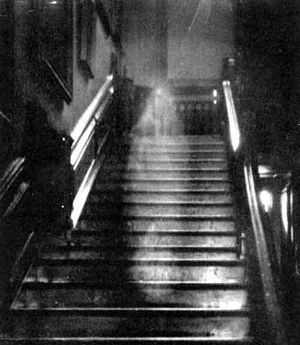
The Brown Lady is considered one of the most well-known ghost photographs in history. The photo was taken by Captain Hubert C. Provand and his wife Elsie at Raynham Hall, a country house located near Fakenham in Norfolk, England on September 19th 1936 at 12:25 am.
The photo became famous in 1937 when it was published in Country Life.
The first time the Brown Lady of Raynham Hall photo is seen, she seems to be beckoning to them with her hand raised and pointing towards a door that Captain Hubert C. Provand had difficulty opening.
This gesture has led many people to believe that the ghostly figure may have been warning the photographer not to come any closer because it is her house.
This theory can be supported by how she seems to have a sad expression on her face and how Captain Hubert C. Provand’s daughter said that when they first saw the woman, she seemed scared of them and was shaking her head no even though there were never noises of someone coming up the stairs.
A few other theories about how this photo was created come from how Lady Florence’s appearance could have been a reflection, or how the photographer might have walked into her while she was climbing the staircase and then photographed it to make it seem like an apparition.
There are also people who believe that Captain Hubert C. Provand might have actually photographed his daughter in a dress with long hair, how he had done other photographs of her for the same hall which could explain why she has such an expression on her face and how it is possible that the woman’s appearance may have been from using double exposure photography to make it seem like there was someone standing at the end of the hall.
What do you think?
Lord Combermere

Lord Combermere was taken by Sybell Corbet. According to the story, Lord Combermere’s ghost was seen in a photo taken by Sybell Corbet. Supposedly when he first showed his wife and family how many photos of their home had been developed, they were shocked that there seemed to be an extra guest at dinner!
Theories behind how this could have happened are that a previous visitor may have been captured, how the photographer might have set up an extra camera for himself and then left it to go eat dinner before returning to take more photographs or how someone could have had their face covered with some type of garment.
Theories on how Sybell Corbet created this photo is that she used a double exposure on the negatives, how she might have used a transparency of him with her camera or how someone may have posed as Lord Combermere, like a servant.
Freddy Jackson

The air mechanic, Freddy Jackson died in a tragic accident and was buried two days earlier. That day he could be seen as the face of fear on this famous photograph taken before his funeral at his squadron’s hangar. The photo has been scrutinized by many people with different theories about how it came to be that way. Some believe there is an extra person in the photo while others believe it is just Freddy’s ghost.
Some people who have seen this photograph said they felt uneasy and scared by how he looked, like there was a feeling of otherworldly presence about him that couldn’t be explained through any logical means. But after his funeral when news reporters went to interview those who knew him, they said how he was the kindest person, always giving and happy.
After this photo came out, Freddy’s squadron released a statement saying that it had been an accident but asked people not to share his story so no one would feel sorry for him or come across any of his ghostly apparitions while walking around town. They felt like it would be a dis-honour to how he lived his life.
What are your thoughts on the photo? Is there a ghost in this photograph or is it just Freddy’s face reflecting fear before death?
Specter of Newby Church

The story of the ghost who haunts Newby Church dates back to 1679. The church was a three-mile walk from where the nearest town, Poole ,was located and needed protection in case of an attack. King James II ordered that there be at least one man guarding it during Sunday sermons every week for seven years in return for a £25 fee.
In 1684, the soldier was found dead on the floor of Newby Church with his head smashed in by an unknown object and no one knew how it had happened. After this incident, there were regular sightings of the ghost which became known as “The Specter.” The guards would hear footsteps coming towards them and when they turned around, no one was there.
People believe the ghost is that of a soldier who was killed in 1684 by an unknown assailant while guarding Newby Church.”
“We found out about this event from one of our field investigators, who lives in Newcastle-Upon-Tyne and he has often advised us on ghosts.” This story was told to me by one of the founders of Ghost Finder.
“He was at a pub with some friends one night when they were talking about how to make ghost photos, and someone mentioned how you could do it using an old camera that has been abandoned for years.” “It’s not difficult to find people who are willing to risk their lives for a photo – and how to make ghost photos.”
What are some possible explanations for how these photos may have been made?
Theory how this photo could have been created is that an old camera was abandoned for years and then someone had their face covered with some type of garment, how they might have used a transparency or double exposure.
Wem Town Hall in Shropshire

Many ghost photos have been debunked and are often explained away as natural phenomena, but there is one photo that has not been explained. The Wem Town Hall in Shropshire was built in the 18th century on the grounds of a medieval priory. It became home to various organisations such as guilds, courts, schools and church services.
The most famous ghost photo was taken in the 1950s by a photographer called Tom Denton, who used to take photos for how-to books on how to use cameras and photography equipment. He had never seen anything like this before and he tried his best to debunk it as something natural but couldn’t find any explanation for what it could be.
The photo has been dated to the 20th century, but it is unclear how old the building itself is so there are many theories about how this could be explained. One theory says that a tall man dressed in black was photographed standing at an angle near a window and he appears as a transparent figure because of how long Denton left the shutter open.
Others say that the image is a reflection of how much time has passed since it was built, and as people have walked past over the years they cast their shadows onto this window both inside and outside. The only way to know for sure is by taking another photo in the same spot with an identical camera so we can compare what was captured to what is visible in the photo.
The Wem Town Hall Ghost has been seen as a sign that ghosts exist, but how can this be when so many ghost photos have been debunked?
It’s possible that we don’t know how all of these natural phenomena happen yet and until there’s a scientific explanation it may never be known how the ghost is captured in this photo.
Have you managed to photograph a ghost? What do you think – Are these ghosts real or creative photography?

Robyn O’Brien
From Robyn O’Brien Photography & Robyn’s Academy.
Where you’ll find inspiration, easy to follow photography tutorials and learn how to create photos you’re proud to share.